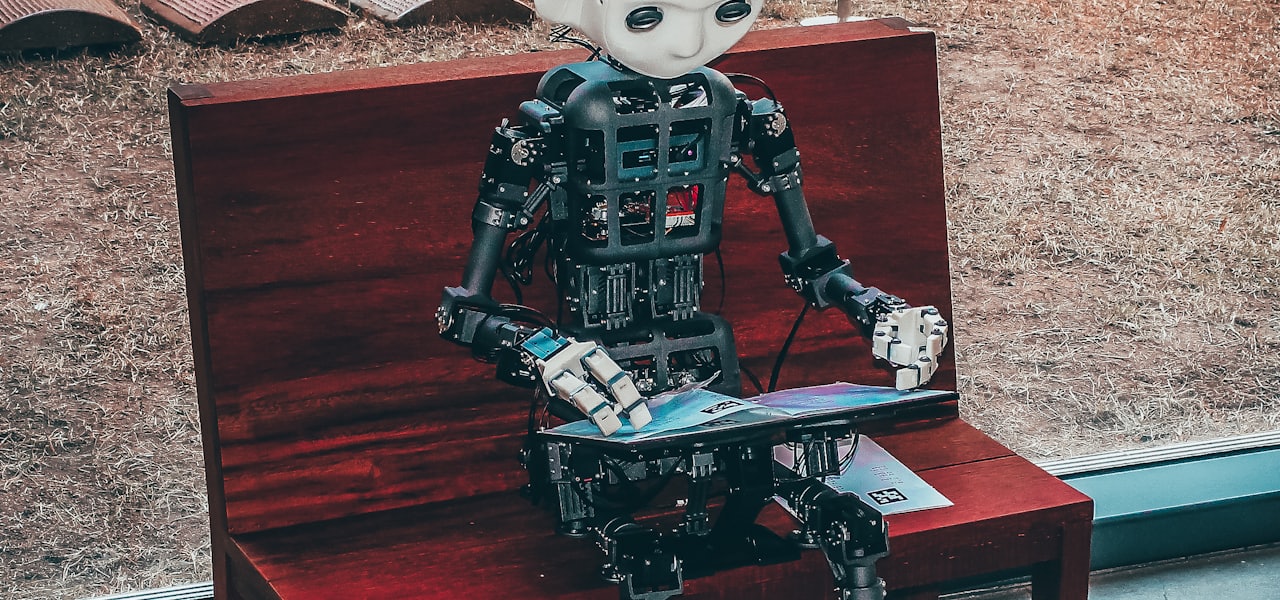
AI Essay Prompt

AI Essay Prompt — independent reviews, comparisons, pricing and step-by-step guides on Aizhi.

  • Workplace impact of artificial intelligence

    Workplace impact of artificial intelligence

    The impact of artificial intelligence on workers includes both applications to improve worker safety and health, and potential hazards that must be controlled. One potential application is using AI to eliminate hazards by removing humans from hazardous situations that involve risk of stress, overwork, or musculoskeletal injuries. Predictive analytics may also be used to identify conditions that may lead to hazards such as fatigue, repetitive strain injuries, or toxic substance exposure, leading to earlier interventions. Another is to streamline workplace safety and health workflows through automating repetitive tasks, enhancing safety training programs through virtual reality, or detecting and reporting near misses. When used in the workplace, AI also presents the possibility of new hazards. These may arise from machine learning techniques leading to unpredictable behavior and inscrutability in their decision-making, or from cybersecurity and information privacy issues. Many hazards of AI are psychosocial due to its potential to cause changes in work organization. These include increased monitoring leading to micromanagement, algorithms unintentionally or intentionally mimicking undesirable human biases, and assigning blame for machine errors to the human operator instead. AI may also lead to physical hazards in the form of human–robot collisions, and ergonomic risks of control interfaces and human–machine interactions. Hazard controls include cybersecurity and information privacy measures, communication and transparency with workers about data usage, and limitations on collaborative robots. From a workplace safety and health perspective, only "weak" or "narrow" AI that is tailored to a specific task is relevant, as there are many examples that are currently in use or expected to come into use in the near future. Certain digital technologies are predicted to result in job losses. Starting in the 2020s, the adoption of modern robotics has led to net employment growth. However, many businesses anticipate that automation, or employing robots would result in job losses in the future. This is especially true for companies in Central and Eastern Europe. Other digital technologies, such as platforms or big data, are projected to have a more neutral impact on employment. A large number of tech workers have been laid off starting in 2023; many such job cuts have been attributed to artificial intelligence. == Health and safety applications == In order for any potential AI health and safety application to be adopted, it requires acceptance by both managers and workers. For example, worker acceptance may be diminished by concerns about information privacy, or from a lack of trust and acceptance of the new technology, which may arise from inadequate transparency or training. Alternatively, managers may emphasize increases in economic productivity rather than gains in worker safety and health when implementing AI-based systems. === Eliminating hazardous tasks === AI may increase the scope of work tasks where a worker can be removed from a situation that carries risk. In a sense, while traditional automation can replace the functions of a worker's body with a robot, AI effectively replaces the functions of their brain with a computer. Hazards that can be avoided include stress, overwork, musculoskeletal injuries, and boredom. This can expand the range of affected job sectors into white-collar and service sector jobs such as in medicine, finance, and information technology. === Analytics to reduce risk === Machine learning is used for people analytics to make predictions about worker behavior to assist management decision-making, such as hiring and performance assessment. These could also be used to improve worker health. The analytics may be based on inputs such as online activities, monitoring of communications, location tracking, and voice analysis and body language analysis of filmed interviews. For example, sentiment analysis may be used to spot fatigue to prevent overwork. Decision support systems have a similar ability to be used to, for example, prevent industrial disasters or make disaster response more efficient. For manual material handling workers, predictive analytics and artificial intelligence may be used to reduce musculoskeletal injury. Traditional guidelines are based on statistical averages and are geared towards anthropometrically typical humans. The analysis of large amounts of data from wearable sensors may allow real-time, personalized calculation of ergonomic risk and fatigue management, as well as better analysis of the risk associated with specific job roles. Wearable sensors may also enable earlier intervention against exposure to toxic substances than is possible with area or breathing zone testing on a periodic basis. Furthermore, the large data sets generated could improve workplace health surveillance, risk assessment, and research. === Streamlining safety and health workflows === AI has also been used to attempt to make the workplace safety and health workflow more efficient. One example is coding of workers' compensation claims, which are submitted in a prose narrative form and must manually be assigned standardized codes. AI is being investigated to perform this task faster, more cheaply, and with fewer errors. == Hazards == There are several broad aspects of AI that may give rise to specific hazards. The risks depend on implementation rather than the mere presence of AI. Systems using sub-symbolic AI such as machine learning may behave unpredictably and are more prone to inscrutability in their decision-making. This is especially true if a situation is encountered that was not part of the AI's training dataset, and is exacerbated in environments that are less structured. Undesired behavior may also arise from flaws in the system's perception (arising either from within the software or from sensor degradation), knowledge representation and reasoning, or from software bugs. They may arise from improper training, such as a user applying the same algorithm to two problems that do not have the same requirements. Machine learning applied during the design phase may have different implications than that applied at runtime. Systems using symbolic AI are less prone to unpredictable behavior. The use of AI also increases cybersecurity risks relative to platforms that do not use AI, and information privacy concerns about collected data may pose a hazard to workers. === Psychosocial === Psychosocial hazards are those that arise from the way work is designed, organized, and managed, or its economic and social contexts, rather than arising from a physical substance or object. They cause not only psychiatric and psychological outcomes such as occupational burnout, anxiety disorders, and depression, but they can also cause physical injury or illness such as cardiovascular disease or musculoskeletal injury. Many hazards of AI are psychosocial in nature due to its potential to cause changes in work organization, in terms of increasing complexity and interaction between different organizational factors. However, psychosocial risks are often overlooked by designers of advanced manufacturing systems. Einola and Khoreva explore how different organizational groups perceive and interact with AI technologies. Their research shows that successful AI integration depends on human ownership and contextual understanding. They caution against blind technological optimism and stress the importance of tailoring AI use to specific workplace ecosystems. This perspective reinforces the need for inclusive design and transparent implementation strategies. ==== Changes in work practices ==== Over-reliance on AI tools may lead to deskilling of some professions. When AI becomes a substitute for traditional peer collaboration and mentorship, there is a risk of diminishing opportunities for interpersonal skill development and team-based learning. Increased monitoring may lead to micromanagement and thus to stress and anxiety. A perception of surveillance may also lead to stress. Controls for these include consultation with worker groups, extensive testing, and attention to introduced bias. Wearable sensors, activity trackers, and augmented reality may also lead to stress from micromanagement, both for assembly line workers and gig workers. Gig workers also lack the legal protections and rights of formal workers. Newell & Marabelli argue that AI alters power dynamics and employee autonomy, requiring a more nuanced understanding of its social and organizational implications. There is also the risk of people being forced to work at a robot's pace, or to monitor robot performance at nonstandard hours. A 2025 preprint paper based on users' interactions with the AI chatbot Microsoft Copilot identified forty jobs that the author's claimed had high overlaps with the capabilities of AI. Some media outlets used this paper to report on jobs becoming obsolete. Cri

    Read more →
  • Rule-based machine learning

    Rule-based machine learning

    Rule-based machine learning (RBML) is a term in computer science intended to encompass any machine learning method that identifies, learns, or evolves 'rules' to store, manipulate or apply. The defining characteristic of a rule-based machine learner is the identification and utilization of a set of relational rules that collectively represent the knowledge captured by the system. Rule-based machine learning approaches include learning classifier systems, association rule learning, artificial immune systems, and any other method that relies on a set of rules, each covering contextual knowledge. While rule-based machine learning is conceptually a type of rule-based system, it is distinct from traditional rule-based systems, which are often hand-crafted, and other rule-based decision makers. This is because rule-based machine learning applies some form of learning algorithm such as Rough sets theory to identify and minimise the set of features and to automatically identify useful rules, rather than a human needing to apply prior domain knowledge to manually construct rules and curate a rule set. == Rules == Rules typically take the form of an '{IF:THEN} expression', (e.g. {IF 'condition' THEN 'result'}, or as a more specific example, {IF 'red' AND 'octagon' THEN 'stop-sign}). An individual rule is not in itself a model, since the rule is only applicable when its condition is satisfied. Therefore rule-based machine learning methods typically comprise a set of rules, or knowledge base, that collectively make up the prediction model usually known as decision algorithm. Rules can also be interpreted in various ways depending on the domain knowledge, data types(discrete or continuous) and in combinations. == RIPPER == Repeated incremental pruning to produce error reduction (RIPPER) is a propositional rule learner proposed by William W. Cohen as an optimized version of IREP.

    Read more →
  • Principal component analysis

    Principal component analysis

    Principal component analysis (PCA) is a linear dimensionality reduction technique with applications in exploratory data analysis, visualization and data preprocessing. The data are linearly transformed onto a new coordinate system such that the directions (principal components) capturing the largest variation in the data can be easily identified. The principal components of a collection of points in a real coordinate space are a sequence of p {\displaystyle p} unit vectors, where the i {\displaystyle i} -th vector is the direction of a line that best fits the data while being orthogonal to the first i − 1 {\displaystyle i-1} vectors. Here, a best-fitting line is defined as one that minimizes the average squared perpendicular distance from the points to the line. These directions (i.e., principal components) constitute an orthonormal basis in which different individual dimensions of the data are linearly uncorrelated. Many studies use the first two principal components in order to plot the data in two dimensions and to visually identify clusters of closely related data points. Principal component analysis has applications in many fields such as population genetics, microbiome studies, and atmospheric science. == Overview == When performing PCA, the first principal component of a set of p {\displaystyle p} variables is the derived variable formed as a linear combination of the original variables that explains the most variance. The second principal component explains the most variance in what is left once the effect of the first component is removed, and we may proceed through p {\displaystyle p} iterations until all the variance is explained. PCA is most commonly used when many of the variables are highly correlated with each other and it is desirable to reduce their number to an independent set. The first principal component can equivalently be defined as a direction that maximizes the variance of the projected data. The i {\displaystyle i} -th principal component can be taken as a direction orthogonal to the first i − 1 {\displaystyle i-1} principal components that maximizes the variance of the projected data. For either objective, it can be shown that the principal components are eigenvectors of the data's covariance matrix. Thus, the principal components are often computed by eigendecomposition of the data covariance matrix or singular value decomposition of the data matrix. PCA is the simplest of the true eigenvector-based multivariate analyses and is closely related to factor analysis. Factor analysis typically incorporates more domain-specific assumptions about the underlying structure and solves eigenvectors of a slightly different matrix. PCA is also related to canonical correlation analysis (CCA). CCA defines coordinate systems that optimally describe the cross-covariance between two datasets while PCA defines a new orthogonal coordinate system that optimally describes variance in a single dataset. Robust and L1-norm-based variants of standard PCA have also been proposed. == History == PCA was invented in 1901 by Karl Pearson, as an analogue of the principal axis theorem in mechanics; it was later independently developed and named by Harold Hotelling in the 1930s. Depending on the field of application, it is also named the discrete Karhunen–Loève transform (KLT) in signal processing, the Hotelling transform in multivariate quality control, proper orthogonal decomposition (POD) in mechanical engineering, singular value decomposition (SVD) of X (invented in the last quarter of the 19th century), eigenvalue decomposition (EVD) of XTX in linear algebra, factor analysis (for a discussion of the differences between PCA and factor analysis see Ch. 7 of Jolliffe's Principal Component Analysis), Eckart–Young theorem (Harman, 1960), or empirical orthogonal functions (EOF) in meteorological science (Lorenz, 1956), empirical eigenfunction decomposition (Sirovich, 1987), quasiharmonic modes (Brooks et al., 1988), spectral decomposition in noise and vibration, and empirical modal analysis in structural dynamics. == Intuition == PCA can be thought of as fitting a p-dimensional ellipsoid to the data, where each axis of the ellipsoid represents a principal component. If some axis of the ellipsoid is small, then the variance along that axis is also small. To find the axes of the ellipsoid, we must first center the values of each variable in the dataset on 0 by subtracting the mean of the variable's observed values from each of those values. These transformed values are used instead of the original observed values for each of the variables. Then, we compute the covariance matrix of the data and calculate the eigenvalues and corresponding eigenvectors of this covariance matrix. Then we must normalize each of the orthogonal eigenvectors to turn them into unit vectors. Once this is done, each of the mutually-orthogonal unit eigenvectors can be interpreted as an axis of the ellipsoid fitted to the data. This choice of basis will transform the covariance matrix into a diagonalized form, in which the diagonal elements represent the variance of each axis. The proportion of the variance that each eigenvector represents can be calculated by dividing the eigenvalue corresponding to that eigenvector by the sum of all eigenvalues. Biplots and scree plots (degree of explained variance) are used to interpret findings of the PCA. == Details == PCA is defined as an orthogonal linear transformation on a real inner product space that transforms the data to a new coordinate system such that the greatest variance by some scalar projection of the data comes to lie on the first coordinate (called the first principal component), the second greatest variance on the second coordinate, and so on. Consider an n × p {\displaystyle n\times p} data matrix, X, with column-wise zero empirical mean (the sample mean of each column has been shifted to zero), where each of the n rows represents a different repetition of the experiment, and each of the p columns gives a particular kind of feature (say, the results from a particular sensor). Mathematically, the transformation is defined by a set of size l {\displaystyle l} (where l {\displaystyle l} is usually selected to be strictly less than p {\displaystyle p} to reduce dimensionality) of p {\displaystyle p} -dimensional vectors of weights or coefficients w ( k ) = ( w 1 , … , w p ) ( k ) {\displaystyle \mathbf {w} _{(k)}=(w_{1},\dots ,w_{p})_{(k)}} that map each row vector x ( i ) = ( x 1 , … , x p ) ( i ) {\displaystyle \mathbf {x} _{(i)}=(x_{1},\dots ,x_{p})_{(i)}} of X to a new vector of principal component scores t ( i ) = ( t 1 , … , t l ) ( i ) {\displaystyle \mathbf {t} _{(i)}=(t_{1},\dots ,t_{l})_{(i)}} , given by t k ( i ) = x ( i ) ⋅ w ( k ) f o r i = 1 , … , n k = 1 , … , l {\displaystyle {t_{k}}_{(i)}=\mathbf {x} _{(i)}\cdot \mathbf {w} _{(k)}\qquad \mathrm {for} \qquad i=1,\dots ,n\qquad k=1,\dots ,l} in such a way that the individual variables t 1 , … , t l {\displaystyle t_{1},\dots ,t_{l}} of t considered over the data set successively inherit the maximum possible variance from X, with each coefficient vector w constrained to be a unit vector. The above may equivalently be written in matrix form as T = X W {\displaystyle \mathbf {T} =\mathbf {X} \mathbf {W} } where T i k = t k ( i ) {\displaystyle {\mathbf {T} }_{ik}={t_{k}}_{(i)}} , X i j = x j ( i ) {\displaystyle {\mathbf {X} }_{ij}={x_{j}}_{(i)}} , and W j k = w j ( k ) {\displaystyle {\mathbf {W} }_{jk}={w_{j}}_{(k)}} . === First component === In order to maximize variance, the first weight vector w(1) thus has to satisfy w ( 1 ) = arg ⁡ max ‖ w ‖ = 1 { ∑ i ( t 1 ) ( i ) 2 } = arg ⁡ max ‖ w ‖ = 1 { ∑ i ( x ( i ) ⋅ w ) 2 } {\displaystyle \mathbf {w} _{(1)}=\arg \max _{\Vert \mathbf {w} \Vert =1}\,\left\{\sum _{i}(t_{1})_{(i)}^{2}\right\}=\arg \max _{\Vert \mathbf {w} \Vert =1}\,\left\{\sum _{i}\left(\mathbf {x} _{(i)}\cdot \mathbf {w} \right)^{2}\right\}} Equivalently, writing this in matrix form gives w ( 1 ) = arg ⁡ max ‖ w ‖ = 1 { ‖ X w ‖ 2 } = arg ⁡ max ‖ w ‖ = 1 { w T X T X w } {\displaystyle \mathbf {w} _{(1)}=\arg \max _{\left\|\mathbf {w} \right\|=1}\left\{\left\|\mathbf {Xw} \right\|^{2}\right\}=\arg \max _{\left\|\mathbf {w} \right\|=1}\left\{\mathbf {w} ^{\mathsf {T}}\mathbf {X} ^{\mathsf {T}}\mathbf {Xw} \right\}} Since w(1) has been defined to be a unit vector, it equivalently also satisfies w ( 1 ) = arg ⁡ max { w T X T X w w T w } {\displaystyle \mathbf {w} _{(1)}=\arg \max \left\{{\frac {\mathbf {w} ^{\mathsf {T}}\mathbf {X} ^{\mathsf {T}}\mathbf {Xw} }{\mathbf {w} ^{\mathsf {T}}\mathbf {w} }}\right\}} The quantity to be maximised can be recognised as a Rayleigh quotient. A standard result for a positive semidefinite matrix such as XTX is that the quotient's maximum possible value is the largest eigenvalue of the matrix, which occurs when w is the corresponding eigenvector. With w(1) found, the first principal component of a data vector

    Read more →
  • Inverted pendulum

    Inverted pendulum

    An inverted pendulum is a pendulum that has its center of mass above its pivot point. It is unstable and falls over without additional help. It can be suspended stably in this inverted position by using a control system to monitor the angle of the pole and move the pivot point horizontally back under the center of mass when it starts to fall over, keeping it balanced. The inverted pendulum is a classic problem in dynamics and control theory and is used as a benchmark for testing control strategies. It is often implemented with the pivot point mounted on a cart that can move horizontally under control of an electronic servo system as shown in the photo; this is called a cart and pole apparatus. Most applications limit the pendulum to 1 degree of freedom by affixing the pole to an axis of rotation. Whereas a normal pendulum is stable when hanging downward, an inverted pendulum is inherently unstable, and must be actively balanced in order to remain upright; this can be done either by applying a torque at the pivot point, by moving the pivot point horizontally as part of a feedback system, changing the rate of rotation of a mass mounted on the pendulum on an axis parallel to the pivot axis and thereby generating a net torque on the pendulum, or by oscillating the pivot point vertically. A simple demonstration of moving the pivot point in a feedback system is achieved by balancing an upturned broomstick on the end of one's finger. A second type of inverted pendulum is a tiltmeter for tall structures, which consists of a wire anchored to the bottom of the foundation and attached to a float in a pool of oil at the top of the structure that has devices for measuring movement of the neutral position of the float away from its original position. == Overview == A pendulum with its bob hanging directly below the support pivot is at a stable equilibrium point, where it remains motionless because there is no torque on the pendulum. If displaced from this position, it experiences a restoring torque that returns it toward the equilibrium position. A pendulum with its bob in an inverted position, supported on a rigid rod directly above the pivot, 180° from its stable equilibrium position, is at an unstable equilibrium point. At this point again there is no torque on the pendulum, but the slightest displacement away from this position causes a gravitation torque on the pendulum that accelerates it away from equilibrium, causing it to fall over. In order to stabilize a pendulum in this inverted position, a feedback control system can be used, which monitors the pendulum's angle and moves the position of the pivot point sideways when the pendulum starts to fall over, to keep it balanced. The inverted pendulum is a classic problem in dynamics and control theory and is widely used as a benchmark for testing control algorithms (PID controllers, state-space representation, neural networks, fuzzy control, genetic algorithms, etc.). Variations on this problem include multiple links, allowing the motion of the cart to be commanded while maintaining the pendulum, and balancing the cart-pendulum system on a see-saw. The inverted pendulum is related to rocket or missile guidance, where the center of gravity is located behind the center of drag causing aerodynamic instability. The understanding of a similar problem can be shown by simple robotics in the form of a balancing cart. Balancing an upturned broomstick on the end of one's finger is a simple demonstration, and the problem is solved by self-balancing personal transporters such as the Segway PT, the self-balancing hoverboard and the self-balancing unicycle. Another way that an inverted pendulum may be stabilized, without any feedback or control mechanism, is by oscillating the pivot rapidly up and down. This is called Kapitza's pendulum. If the oscillation is sufficiently strong (in terms of its acceleration and amplitude) then the inverted pendulum can recover from perturbations in a strikingly counterintuitive manner. If the driving point moves in simple harmonic motion, the pendulum's motion is described by the Mathieu equation. == Equations of motion == The equations of motion of inverted pendulums are dependent on what constraints are placed on the motion of the pendulum. Inverted pendulums can be created in various configurations resulting in a number of Equations of Motion describing the behavior of the pendulum. === Stationary pivot point === In a configuration where the pivot point of the pendulum is fixed in space, the equation of motion is similar to that for an uninverted pendulum. The equation of motion below assumes no friction or any other resistance to movement, a rigid massless rod, and the restriction to 2-dimensional movement. θ ¨ − g ℓ sin ⁡ θ = 0 {\displaystyle {\ddot {\theta }}-{g \over \ell }\sin \theta =0} Where θ ¨ {\displaystyle {\ddot {\theta }}} is the angular acceleration of the pendulum, g {\displaystyle g} is the standard gravity on the surface of the Earth, ℓ {\displaystyle \ell } is the length of the pendulum, and θ {\displaystyle \theta } is the angular displacement measured from the equilibrium position. When θ ¨ {\displaystyle {\ddot {\theta }}} added to both sides, it has the same sign as the angular acceleration term: θ ¨ = g ℓ sin ⁡ θ {\displaystyle {\ddot {\theta }}={g \over \ell }\sin \theta } Thus, the inverted pendulum accelerates away from the vertical unstable equilibrium in the direction initially displaced, and the acceleration is inversely proportional to the length. Tall pendulums fall more slowly than short ones. Derivation using torque and moment of inertia: The pendulum is assumed to consist of a point mass, of mass m {\displaystyle m} , affixed to the end of a massless rigid rod, of length ℓ {\displaystyle \ell } , attached to a pivot point at the end opposite the point mass. The net torque of the system must equal the moment of inertia times the angular acceleration: τ n e t = I θ ¨ {\displaystyle {\boldsymbol {\tau }}_{\mathrm {net} }=I{\ddot {\theta }}} The torque due to gravity providing the net torque: τ n e t = m g ℓ sin ⁡ θ {\displaystyle {\boldsymbol {\tau }}_{\mathrm {net} }=mg\ell \sin \theta \,\!} Where θ {\displaystyle \theta \ } is the angle measured from the inverted equilibrium position. The resulting equation: I θ ¨ = m g ℓ sin ⁡ θ {\displaystyle I{\ddot {\theta }}=mg\ell \sin \theta \,\!} The moment of inertia for a point mass: I = m R 2 {\displaystyle I=mR^{2}} In the case of the inverted pendulum the radius is the length of the rod, ℓ {\displaystyle \ell } . Substituting in I = m ℓ 2 {\displaystyle I=m\ell ^{2}} m ℓ 2 θ ¨ = m g ℓ sin ⁡ θ {\displaystyle m\ell ^{2}{\ddot {\theta }}=mg\ell \sin \theta \,\!} Mass and ℓ 2 {\displaystyle \ell ^{2}} is divided from each side resulting in: θ ¨ = g ℓ sin ⁡ θ {\displaystyle {\ddot {\theta }}={g \over \ell }\sin \theta } === Inverted pendulum on a cart === An inverted pendulum on a cart consists of a mass m {\displaystyle m} at the top of a pole of length ℓ {\displaystyle \ell } pivoted on a horizontally moving base as shown in the adjacent image. The cart is restricted to linear motion and is subject to forces resulting in or hindering motion. === Essentials of stabilization === The essentials of stabilizing the inverted pendulum can be summarized qualitatively in three steps. 1. If the tilt angle θ {\displaystyle \theta } is to the right, the cart must accelerate to the right and vice versa. 2. The position of the cart x {\displaystyle x} relative to track center is stabilized by slightly modulating the null angle (the angle error that the control system tries to null) by the position of the cart, that is, null angle = θ + k x {\displaystyle =\theta +kx} where k {\displaystyle k} is small. This makes the pole want to lean slightly toward track center and stabilize at track center where the tilt angle is exactly vertical. Any offset in the tilt sensor or track slope that would otherwise cause instability translates into a stable position offset. A further added offset gives position control. 3. A normal pendulum subject to a moving pivot point such as a load lifted by a crane, has a peaked response at the pendulum radian frequency of ω p = g / ℓ {\displaystyle \omega _{p}={\sqrt {g/\ell }}} . To prevent uncontrolled swinging, the frequency spectrum of the pivot motion should be suppressed near ω p {\displaystyle \omega _{p}} . The inverted pendulum requires the same suppression filter to achieve stability. As a consequence of the null angle modulation strategy, the position feedback is positive, that is, a sudden command to move right produces an initial cart motion to the left followed by a move right to rebalance the pendulum. The interaction of the pendulum instability and the positive position feedback instability to produce a stable system is a feature that makes the mathematical analysis an interesting and challenging problem. === From Lagrange's equations === The equations of motion c

    Read more →
  • Line integral convolution

    Line integral convolution

    In scientific visualization, line integral convolution (LIC) is a method to visualize a vector field (such as fluid motion) at high spatial resolutions. The LIC technique was first proposed by Brian Cabral and Leith Casey Leedom in 1993. In LIC, discrete numerical line integration is performed along the field lines (curves) of the vector field on a uniform grid. The integral operation is a convolution of a filter kernel and an input texture, often white noise. In signal processing, this process is known as a discrete convolution. == Overview == Traditional visualizations of vector fields use small arrows or lines to represent vector direction and magnitude. This method has a low spatial resolution, which limits the density of presentable data and risks obscuring characteristic features in the data. More sophisticated methods, such as streamlines and particle tracing techniques, can be more revealing but are highly dependent on proper seed points. Texture-based methods, like LIC, avoid these problems since they depict the entire vector field at point-like (pixel) resolution. Compared to other integration-based techniques that compute field lines of the input vector field, LIC has the advantage that all structural features of the vector field are displayed, without the need to adapt the start and end points of field lines to the specific vector field. In other words, it shows the topology of the vector field. In user testing, LIC was found to be particularly good for identifying critical points. == Algorithm == === Informal description === LIC causes output values to be strongly correlated along the field lines, but uncorrelated in orthogonal directions. As a result, the field lines contrast each other and stand out visually from the background. Intuitively, the process can be understood with the following example: the flow of a vector field can be visualized by overlaying a fixed, random pattern of dark and light paint. As the flow passes by the paint, the fluid picks up some of the paint's color, averaging it with the color it has already acquired. The result is a randomly striped, smeared texture where points along the same streamline tend to have a similar color. Other physical examples include: whorl patterns of paint, oil, or foam on a river visualisation of magnetic field lines using randomly distributed iron filings fine sand being blown by strong wind === Formal mathematical description === Although the input vector field and the result image are discretized, it pays to look at it from a continuous viewpoint. Let v {\displaystyle \mathbf {v} } be the vector field given in some domain Ω {\displaystyle \Omega } . Although the input vector field is typically discretized, we regard the field v {\displaystyle \mathbf {v} } as defined in every point of Ω {\displaystyle \Omega } , i.e. we assume an interpolation. Streamlines, or more generally field lines, are tangent to the vector field in each point. They end either at the boundary of Ω {\displaystyle \Omega } or at critical points where v = 0 {\displaystyle \mathbf {v} =\mathbf {0} } . For the sake of simplicity, critical points and boundaries are ignored in the following. A field line σ {\displaystyle {\boldsymbol {\sigma }}} , parametrized by arc length s {\displaystyle s} , is defined as d σ ( s ) d s = v ( σ ( s ) ) | v ( σ ( s ) ) | . {\displaystyle {\frac {d{\boldsymbol {\sigma }}(s)}{ds}}={\frac {\mathbf {v} ({\boldsymbol {\sigma }}(s))}{|\mathbf {v} ({\boldsymbol {\sigma }}(s))|}}.} Let σ r ( s ) {\displaystyle {\boldsymbol {\sigma }}_{\mathbf {r} }(s)} be the field line that passes through the point r {\displaystyle \mathbf {r} } for s = 0 {\displaystyle s=0} . Then the image gray value at r {\displaystyle \mathbf {r} } is set to D ( r ) = ∫ − L / 2 L / 2 k ( s ) N ( σ r ( s ) ) d s {\displaystyle D(\mathbf {r} )=\int _{-L/2}^{L/2}k(s)N({\boldsymbol {\sigma }}_{\mathbf {r} }(s))ds} where k ( s ) {\displaystyle k(s)} is the convolution kernel, N ( r ) {\displaystyle N(\mathbf {r} )} is the noise image, and L {\displaystyle L} is the length of field line segment that is followed. D ( r ) {\displaystyle D(\mathbf {r} )} has to be computed for each pixel in the LIC image. If carried out naively, this is quite expensive. First, the field lines have to be computed using a numerical method for solving ordinary differential equations, like a Runge–Kutta method, and then for each pixel the convolution along a field line segment has to be calculated. The final image will normally be colored in some way. Typically, some scalar field in Ω {\displaystyle \Omega } (like the vector length) is used to determine the hue, while the grayscale LIC output determines the brightness. Different choices of convolution kernels and random noise produce different textures; for example, pink noise produces a cloudy pattern where areas of higher flow stand out as smearing, suitable for weather visualization. Further refinements in the convolution can improve the quality of the image. === Programming description === Algorithmically, LIC takes a vector field and noise texture as input, and outputs a texture. The process starts by generating in the domain of the vector field a random gray level image at the desired output resolution. Then, for every pixel in this image, the forward and backward streamline of a fixed arc length is calculated. The value assigned to the current pixel is computed by a convolution of a suitable convolution kernel with the gray levels of all the noise pixels lying on a segment of this streamline. This creates a gray level LIC image. == Versions == === Basic === Basic LIC images are grayscale images, without color and animation. While such LIC images convey the direction of the field vectors, they do not indicate orientation; for stationary fields, this can be remedied by animation. Basic LIC images do not show the length of the vectors (or the strength of the field). === Color === The length of the vectors (or the strength of the field) is usually coded in color; alternatively, animation can be used. === Animation === LIC images can be animated by using a kernel that changes over time. Samples at a constant time from the streamline would still be used, but instead of averaging all pixels in a streamline with a static kernel, a ripple-like kernel constructed from a periodic function multiplied by a Hann function acting as a window (in order to prevent artifacts) is used. The periodic function is then shifted along the period to create an animation. === Fast LIC (FLIC) === The computation can be significantly accelerated by re-using parts of already computed field lines, specializing to a box function as convolution kernel k ( s ) {\displaystyle k(s)} and avoiding redundant computations during convolution. The resulting fast LIC method can be generalized to convolution kernels that are arbitrary polynomials. === Oriented Line Integral Convolution (OLIC) === Because LIC does not encode flow orientation, it cannot distinguish between streamlines of equal direction but opposite orientation. Oriented Line Integral Convolution (OLIC) solves this issue by using a ramp-like asymmetric kernel and a low-density noise texture. The kernel asymmetrically modulates the intensity along the streamline, producing a trace that encodes orientation; the low-density of the noise texture prevents smeared traces from overlapping, aiding readability. Fast Rendering of Oriented Line Integral Convolution (FROLIC) is a variation that approximates OLIC by rendering each trace in discrete steps instead of as a continuous smear. === Unsteady Flow LIC (UFLIC) === For time-dependent vector fields (unsteady flow), a variant called Unsteady Flow LIC has been designed that maintains the coherence of the flow animation. An interactive GPU-based implementation of UFLIC has been presented. === Parallel === Since the computation of an LIC image is expensive but inherently parallel, the process has been parallelized and, with availability of GPU-based implementations, interactive on PCs. === Multidimensional === Note that the domain Ω {\displaystyle \Omega } does not have to be a 2D domain: the method is applicable to higher dimensional domains using multidimensional noise fields. However, the visualization of the higher-dimensional LIC texture is problematic; one way is to use interactive exploration with 2D slices that are manually positioned and rotated. The domain Ω {\displaystyle \Omega } does not have to be flat either; the LIC texture can be computed also for arbitrarily shaped 2D surfaces in 3D space. == Applications == This technique has been applied to a wide range of problems since it first was published in 1993, both scientific and creative, including: Representing vector fields: visualization of steady (time-independent) flows (streamlines) visual exploration of 2D autonomous dynamical systems wind mapping water flow mapping Artistic effects for image generation and stylization: pencil drawing (auto

    Read more →
  • Variational message passing

    Variational message passing

    Variational message passing (VMP) is an approximate inference technique for continuous- or discrete-valued Bayesian networks, with conjugate-exponential parents, developed by John Winn. VMP was developed as a means of generalizing the approximate variational methods used by such techniques as latent Dirichlet allocation, and works by updating an approximate distribution at each node through messages in the node's Markov blanket. == Likelihood lower bound == Given some set of hidden variables H {\displaystyle H} and observed variables V {\displaystyle V} , the goal of approximate inference is to maximize a lower-bound on the probability that a graphical model is in the configuration V {\displaystyle V} . Over some probability distribution Q {\displaystyle Q} (to be defined later), ln ⁡ P ( V ) = ∑ H Q ( H ) ln ⁡ P ( H , V ) P ( H | V ) = ∑ H Q ( H ) [ ln ⁡ P ( H , V ) Q ( H ) − ln ⁡ P ( H | V ) Q ( H ) ] {\displaystyle \ln P(V)=\sum _{H}Q(H)\ln {\frac {P(H,V)}{P(H|V)}}=\sum _{H}Q(H){\Bigg [}\ln {\frac {P(H,V)}{Q(H)}}-\ln {\frac {P(H|V)}{Q(H)}}{\Bigg ]}} . So, if we define our lower bound to be L ( Q ) = ∑ H Q ( H ) ln ⁡ P ( H , V ) Q ( H ) {\displaystyle L(Q)=\sum _{H}Q(H)\ln {\frac {P(H,V)}{Q(H)}}} , then the likelihood is simply this bound plus the relative entropy between P {\displaystyle P} and Q {\displaystyle Q} . Because the relative entropy is non-negative, the function L {\displaystyle L} defined above is indeed a lower bound of the log likelihood of our observation V {\displaystyle V} . The distribution Q {\displaystyle Q} will have a simpler character than that of P {\displaystyle P} because marginalizing over P {\displaystyle P} is intractable for all but the simplest of graphical models. In particular, VMP uses a factorized distribution Q ( H ) = ∏ i Q i ( H i ) , {\displaystyle Q(H)=\prod _{i}Q_{i}(H_{i}),} where H i {\displaystyle H_{i}} is a disjoint part of the graphical model. == Determining the update rule == The likelihood estimate needs to be as large as possible; because it's a lower bound, getting closer log ⁡ P {\displaystyle \log P} improves the approximation of the log likelihood. By substituting in the factorized version of Q {\displaystyle Q} , L ( Q ) {\displaystyle L(Q)} , parameterized over the hidden nodes H i {\displaystyle H_{i}} as above, is simply the negative relative entropy between Q j {\displaystyle Q_{j}} and Q j ∗ {\displaystyle Q_{j}^{}} plus other terms independent of Q j {\displaystyle Q_{j}} if Q j ∗ {\displaystyle Q_{j}^{}} is defined as Q j ∗ ( H j ) = 1 Z e E − j { ln ⁡ P ( H , V ) } {\displaystyle Q_{j}^{}(H_{j})={\frac {1}{Z}}e^{\mathbb {E} _{-j}\{\ln P(H,V)\}}} , where E − j { ln ⁡ P ( H , V ) } {\displaystyle \mathbb {E} _{-j}\{\ln P(H,V)\}} is the expectation over all distributions Q i {\displaystyle Q_{i}} except Q j {\displaystyle Q_{j}} . Thus, if we set Q j {\displaystyle Q_{j}} to be Q j ∗ {\displaystyle Q_{j}^{}} , the bound L {\displaystyle L} is maximized. == Messages in variational message passing == Parents send their children the expectation of their sufficient statistic while children send their parents their natural parameter, which also requires messages to be sent from the co-parents of the node. == Relationship to exponential families == Because all nodes in VMP come from exponential families and all parents of nodes are conjugate to their children nodes, the expectation of the sufficient statistic can be computed from the normalization factor. == VMP algorithm == The algorithm begins by computing the expected value of the sufficient statistics for that vector. Then, until the likelihood converges to a stable value (this is usually accomplished by setting a small threshold value and running the algorithm until it increases by less than that threshold value), do the following at each node: Get all messages from parents. Get all messages from children (this might require the children to get messages from the co-parents). Compute the expected value of the nodes sufficient statistics. == Constraints == Because every child must be conjugate to its parent, this has limited the types of distributions that can be used in the model. For example, the parents of a Gaussian distribution must be a Gaussian distribution (corresponding to the Mean) and a gamma distribution (corresponding to the precision, or one over σ {\displaystyle \sigma } in more common parameterizations). Discrete variables can have Dirichlet parents, and Poisson and exponential nodes must have gamma parents. More recently, VMP has been extended to handle models that violate this conditional conjugacy constraint. == Literature == John Winn; Christopher M. Bishop (2005). "Variational Message Passing" (PDF). Journal of Machine Learning Research. 6: 661–694. ISSN 1533-7928. Wikidata Q139488859. Beal, M.J. (2003). Variational Algorithms for Approximate Bayesian Inference (PDF) (PhD). Gatsby Computational Neuroscience Unit, University College London. Archived from the original (PDF) on 2005-04-28. Retrieved 2007-02-15.

    Read more →
  • Probably approximately correct learning

    Probably approximately correct learning

    In computational learning theory, probably approximately correct (PAC) learning is a framework for mathematical analysis of machine learning. It was proposed in 1984 by Leslie Valiant. In this framework, the learner receives samples and must select a generalization function (called the hypothesis) from a certain class of possible functions. The goal is that, with high probability (the "probably" part), the selected function will have low generalization error (the "approximately correct" part). The learner must be able to learn the concept given any arbitrary approximation ratio, probability of success, or distribution of the samples. The model was later extended to treat noise (misclassified samples). An important innovation of the PAC framework is the introduction of computational complexity theory concepts to machine learning. In particular, the learner is expected to find efficient functions (time and space requirements bounded to a polynomial of the example size), and the learner itself must implement an efficient procedure (requiring an example count bounded to a polynomial of the concept size, modified by the approximation and likelihood bounds). == Definitions and terminology == In order to give the definition for something that is PAC-learnable, we first have to introduce some terminology. For the following definitions, two examples will be used. The first is the problem of character recognition given an array of n {\displaystyle n} bits encoding a binary-valued image. The other example is the problem of finding an interval that will correctly classify points within the interval as positive and the points outside of the range as negative. Let X {\displaystyle X} be a set called the instance space or the encoding of all the samples. In the character recognition problem, the instance space is X = { 0 , 1 } n {\displaystyle X=\{0,1\}^{n}} . In the interval problem the instance space, X {\displaystyle X} , is the set of all bounded intervals in R {\displaystyle \mathbb {R} } , where R {\displaystyle \mathbb {R} } denotes the set of all real numbers. A concept is a subset c ⊂ X {\displaystyle c\subset X} . One concept is the set of all patterns of bits in X = { 0 , 1 } n {\displaystyle X=\{0,1\}^{n}} that encode a picture of the letter "P". An example concept from the second example is the set of open intervals, { ( a , b ) ∣ 0 ≤ a ≤ π / 2 , π ≤ b ≤ 13 } {\displaystyle \{(a,b)\mid 0\leq a\leq \pi /2,\pi \leq b\leq {\sqrt {13}}\}} , each of which contains only the positive points. A concept class C {\displaystyle C} is a collection of concepts over X {\displaystyle X} . This could be the set of all subsets of the array of bits that are skeletonized 4-connected (width of the font is 1). Let EX ⁡ ( c , D ) {\displaystyle \operatorname {EX} (c,D)} be a procedure that draws an example, x {\displaystyle x} , using a probability distribution D {\displaystyle D} and gives the correct label c ( x ) {\displaystyle c(x)} , that is 1 if x ∈ c {\displaystyle x\in c} and 0 otherwise. Now, given 0 < ϵ , δ < 1 {\displaystyle 0<\epsilon ,\delta <1} , assume there is an algorithm A {\displaystyle A} and a polynomial p {\displaystyle p} in 1 / ϵ , 1 / δ {\displaystyle 1/\epsilon ,1/\delta } (and other relevant parameters of the class C {\displaystyle C} ) such that, given a sample of size p {\displaystyle p} drawn according to EX ⁡ ( c , D ) {\displaystyle \operatorname {EX} (c,D)} , then, with probability of at least 1 − δ {\displaystyle 1-\delta } , A {\displaystyle A} outputs a hypothesis h ∈ C {\displaystyle h\in C} that has an average error less than or equal to ϵ {\displaystyle \epsilon } on X {\displaystyle X} with the same distribution D {\displaystyle D} . Further if the above statement for algorithm A {\displaystyle A} is true for every concept c ∈ C {\displaystyle c\in C} and for every distribution D {\displaystyle D} over X {\displaystyle X} , and for all 0 < ϵ , δ < 1 {\displaystyle 0<\epsilon ,\delta <1} then C {\displaystyle C} is (efficiently) PAC learnable (or distribution-free PAC learnable). We can also say that A {\displaystyle A} is a PAC learning algorithm for C {\displaystyle C} . == Equivalence == Under some regularity conditions these conditions are equivalent: The concept class C is PAC learnable. The VC dimension of C is finite. C is a uniformly Glivenko-Cantelli class. C is compressible in the sense of Littlestone and Warmuth

    Read more →
  • ARKA descriptors in QSAR

    ARKA descriptors in QSAR

    In computational chemistry and cheminformatics, ARKA descriptors in QSAR are a class of molecular descriptors used in quantitative structure–activity relationship (QSAR) modeling (or related approaches such as QSPR and QSTR), a computational method for predicting the biological activity or toxicity of chemical compounds based on their molecular structure. Molecular descriptors are numerical values that summarize information about a molecule's structure, topology, geometry, or physicochemical properties in a form suitable for machine learning or statistical modeling. ARKA (Arithmetic Residuals in K-Groups Analysis) descriptors differ from traditional descriptors by encoding atomic-level information through recursive autoregression techniques, which aim to capture subtle structural patterns and improve predictive accuracy. They are designed to be both interpretable and well-suited to modeling nonlinear relationships in QSAR studies. == Comparisons == While QSAR is essentially a similarity-based approach, the occurrence of activity/property cliffs may greatly reduce the predictive accuracy of the developed models. The novel Arithmetic Residuals in K-groups Analysis (ARKA) approach is a supervised dimensionality reduction technique developed by the DTC Laboratory, Jadavpur University that can easily identify activity cliffs in a data set. Activity cliffs are similar in their structures but differ considerably in their activity. The basic idea of the ARKA descriptors is to group the conventional QSAR descriptors based on a predefined criterion and then assign weightage to each descriptor in each group. ARKA descriptors have also been used to develop classification-based and regression-based QSAR models with acceptable quality statistics. The ARKA descriptors have been used for the identification of activity cliffs in QSAR studies and/or model development by multiple researchers. A tutorial presentation on the ARKA descriptors is available. Recently a multi-class ARKA framework has been proposed for improved q-RASAR model generation.

    Read more →
  • Semantic neural network

    Semantic neural network

    Semantic neural network (SNN) is based on John von Neumann's neural network [von Neumann, 1966] and Nikolai Amosov M-Network. There are limitations to a link topology for the von Neumann’s network but SNN accept a case without these limitations. Only logical values can be processed, but SNN accept that fuzzy values can be processed too. All neurons into the von Neumann network are synchronized by tacts. For further use of self-synchronizing circuit technique SNN accepts neurons can be self-running or synchronized. In contrast to the von Neumann network there are no limitations for topology of neurons for semantic networks. It leads to the impossibility of relative addressing of neurons as it was done by von Neumann. In this case an absolute readdressing should be used. Every neuron should have a unique identifier that would provide a direct access to another neuron. Of course, neurons interacting by axons-dendrites should have each other's identifiers. An absolute readdressing can be modulated by using neuron specificity as it was realized for biological neural networks. There’s no description for self-reflectiveness and self-modification abilities into the initial description of semantic networks [Dudar Z.V., Shuklin D.E., 2000]. But in [Shuklin D.E. 2004] a conclusion had been drawn about the necessity of introspection and self-modification abilities in the system. For maintenance of these abilities a concept of pointer to neuron is provided. Pointers represent virtual connections between neurons. In this model, bodies and signals transferring through the neurons connections represent a physical body, and virtual connections between neurons are representing an astral body. It is proposed to create models of artificial neuron networks on the basis of virtual machine supporting the opportunity for paranormal effects. SNN is generally used for natural language processing. == Related models == Computational creativity Semantic hashing Semantic Pointer Architecture Sparse distributed memory

    Read more →
  • Swish function

    Swish function

    The swish function is a family of mathematical function defined as follows: swish β ⁡ ( x ) = x sigmoid ⁡ ( β x ) = x 1 + e − β x . {\displaystyle \operatorname {swish} _{\beta }(x)=x\operatorname {sigmoid} (\beta x)={\frac {x}{1+e^{-\beta x}}}.} where β {\displaystyle \beta } can be constant (usually set to 1) or trainable and "sigmoid" refers to the logistic function. The swish family was designed to smoothly interpolate between a linear function and the Rectified linear unit (ReLU) function. When considering positive values, Swish is a particular case of doubly parameterized sigmoid shrinkage function defined in . Variants of the swish function include Mish. == Special values == For β = 0, the function is linear: f(x) = x/2. For β = 1, the function is the Sigmoid Linear Unit (SiLU). For β = 1.702, the function approximates GeLU. With β → ∞, the function converges to ReLU. Thus, the swish family smoothly interpolates between a linear function and the ReLU function. Since swish β ⁡ ( x ) = swish 1 ⁡ ( β x ) / β {\displaystyle \operatorname {swish} _{\beta }(x)=\operatorname {swish} _{1}(\beta x)/\beta } , all instances of swish have the same shape as the default swish 1 {\displaystyle \operatorname {swish} _{1}} , zoomed by β {\displaystyle \beta } . One usually sets β > 0 {\displaystyle \beta >0} . When β {\displaystyle \beta } is trainable, this constraint can be enforced by β = e b {\displaystyle \beta =e^{b}} , where b {\displaystyle b} is trainable. swish 1 ⁡ ( x ) = x 2 + x 2 4 − x 4 48 + x 6 480 + O ( x 8 ) {\displaystyle \operatorname {swish} _{1}(x)={\frac {x}{2}}+{\frac {x^{2}}{4}}-{\frac {x^{4}}{48}}+{\frac {x^{6}}{480}}+O\left(x^{8}\right)} swish 1 ⁡ ( x ) = x 2 tanh ⁡ ( x 2 ) + x 2 swish 1 ⁡ ( x ) + swish − 1 ⁡ ( x ) = x tanh ⁡ ( x 2 ) swish 1 ⁡ ( x ) − swish − 1 ⁡ ( x ) = x {\displaystyle {\begin{aligned}\operatorname {swish} _{1}(x)&={\frac {x}{2}}\tanh \left({\frac {x}{2}}\right)+{\frac {x}{2}}\\\operatorname {swish} _{1}(x)+\operatorname {swish} _{-1}(x)&=x\tanh \left({\frac {x}{2}}\right)\\\operatorname {swish} _{1}(x)-\operatorname {swish} _{-1}(x)&=x\end{aligned}}} == Derivatives == Because swish β ⁡ ( x ) = swish 1 ⁡ ( β x ) / β {\displaystyle \operatorname {swish} _{\beta }(x)=\operatorname {swish} _{1}(\beta x)/\beta } , it suffices to calculate its derivatives for the default case. swish 1 ′ ⁡ ( x ) = x + sinh ⁡ ( x ) 4 cosh 2 ⁡ ( x 2 ) + 1 2 {\displaystyle \operatorname {swish} _{1}'(x)={\frac {x+\sinh(x)}{4\cosh ^{2}\left({\frac {x}{2}}\right)}}+{\frac {1}{2}}} so swish 1 ′ ⁡ ( x ) − 1 2 {\displaystyle \operatorname {swish} _{1}'(x)-{\frac {1}{2}}} is odd. swish 1 ″ ⁡ ( x ) = 1 − x 2 tanh ⁡ ( x 2 ) 2 cosh 2 ⁡ ( x 2 ) {\displaystyle \operatorname {swish} _{1}''(x)={\frac {1-{\frac {x}{2}}\tanh \left({\frac {x}{2}}\right)}{2\cosh ^{2}\left({\frac {x}{2}}\right)}}} so swish 1 ″ ⁡ ( x ) {\displaystyle \operatorname {swish} _{1}''(x)} is even. == History == SiLU was first proposed alongside the GELU in 2016, then again proposed in 2017 as the Sigmoid-weighted Linear Unit (SiL) in reinforcement learning. The SiLU/SiL was then again proposed as the SWISH over a year after its initial discovery, originally proposed without the learnable parameter β, so that β implicitly equaled 1. The swish paper was then updated to propose the activation with the learnable parameter β. In 2017, after performing analysis on ImageNet data, researchers from Google indicated that using this function as an activation function in artificial neural networks improves the performance, compared to ReLU and sigmoid functions. It is believed that one reason for the improvement is that the swish function helps alleviate the vanishing gradient problem during backpropagation.

    Read more →
  • Loss function

    Loss function

    In mathematical optimization and decision theory, a loss function or cost function (sometimes also called an error function) is a function that maps an event or values of one or more variables onto a real number intuitively representing some "cost" associated with the event. An optimization problem seeks to minimize a loss function. An objective function is either a loss function or its opposite (in specific domains, variously called a reward function, a profit function, a utility function, a fitness function, etc.), in which case it is to be maximized. The loss function could include terms from several levels of the hierarchy. In statistics, typically a loss function is used for parameter estimation, and the event in question is some function of the difference between estimated and true values for an instance of data. The concept, as old as Laplace, was reintroduced in statistics by Abraham Wald in the middle of the 20th century. In the context of economics, for example, this is usually economic cost or regret. In classification, it is the penalty for an incorrect classification of an example. In actuarial science, it is used in an insurance context to model benefits paid over premiums, particularly since the works of Harald Cramér in the 1920s. In optimal control, the loss is the penalty for failing to achieve a desired value. In financial risk management, the function is mapped to a monetary loss. == Examples == === Regret === Leonard J. Savage argued that using non-Bayesian methods such as minimax, the loss function should be based on the idea of regret, i.e., the loss associated with a decision should be the difference between the consequences of the best decision that could have been made under circumstances will be known and the decision that was in fact taken before they were known. === Quadratic loss function === The use of a quadratic loss function is common, for example when using least squares techniques. It is often more mathematically tractable than other loss functions because of the properties of variances, as well as being symmetric: an error above the target causes the same loss as the same magnitude of error below the target. If the target is t {\displaystyle t} , then a quadratic loss function is λ ( x ) = C ( t − x ) 2 {\displaystyle \lambda (x)=C(t-x)^{2}\;} for some constant C {\displaystyle C} ; the value of the constant makes no difference to a decision, and can be ignored by setting it equal to 1. This is also known as the squared error loss (SEL). Many common statistics, including t-tests, regression models, design of experiments, and much else, use least squares methods applied using linear regression theory, which is based on the quadratic loss function. The quadratic loss function is also used in linear-quadratic optimal control problems. In these problems, even in the absence of uncertainty, it may not be possible to achieve the desired values of all target variables. Often loss is expressed as a quadratic form in the deviations of the variables of interest from their desired values; this approach is tractable because it results in linear first-order conditions. In the context of stochastic control, the expected value of the quadratic form is used. The quadratic loss assigns more importance to outliers than to the true data due to its square nature, so alternatives like the Huber, log-cosh and SMAE losses are used when the data has many large outliers. === 0-1 loss function === In statistics and decision theory, a frequently used loss function is the 0-1 loss function L ( y ^ , y ) = { 0 if y = y ^ 1 if y ≠ y ^ {\displaystyle L({\hat {y}},y)={\begin{cases}0&{\text{if }}y={\hat {y}}\\1&{\text{if }}y\neq {\hat {y}}\end{cases}}} In information theory, this loss function is known as Hamming distortion. == Constructing loss and objective functions == In many applications, objective functions, including loss functions as a particular case, are determined by the problem formulation. In other situations, the decision maker’s preference must be elicited and represented by a scalar-valued function (called also utility function) in a form suitable for optimization — the problem that Ragnar Frisch has highlighted in his Nobel Prize lecture. The existing methods for constructing objective functions are collected in the proceedings of two dedicated conferences. In particular, Andranik Tangian showed that the most usable objective functions — quadratic and additive — are determined by a few indifference points. He used this property in the models for constructing these objective functions from either ordinal or cardinal data that were elicited through computer-assisted interviews with decision makers. Among other things, he constructed objective functions to optimally distribute budgets for 16 Westfalian universities and the European subsidies for equalizing unemployment rates among 271 German regions. == Expected loss == In some contexts, the value of the loss function itself is a random quantity because it depends on the outcome of a random variable X {\displaystyle X} . === Statistics === Both frequentist and Bayesian statistical theory involve making a decision based on the expected value of the loss function; however, this quantity is defined differently under the two paradigms. ==== Frequentist expected loss ==== We first define the expected loss in the frequentist context. It is obtained by taking the expected value with respect to the probability distribution, P θ {\displaystyle P_{\theta }} , of the observed data, X {\displaystyle X} . This is also referred to as the risk function of the decision rule δ {\displaystyle \delta } and the parameter θ {\displaystyle \theta } . Here the decision rule depends on the outcome of X {\displaystyle X} . The risk function is given by: R ( θ , δ ) = E θ ⁡ L ( θ , δ ( X ) ) = ∫ X L ( θ , δ ( x ) ) d P θ ( x ) . {\displaystyle R(\theta ,\delta )=\operatorname {E} _{\theta }L{\big (}\theta ,\delta (X){\big )}=\int _{X}L{\big (}\theta ,\delta (x){\big )}\,\mathrm {d} P_{\theta }(x).} Here, θ {\displaystyle \theta } is a fixed but possibly unknown state of nature, X {\displaystyle X} is a vector of observations stochastically drawn from a population, E θ {\displaystyle \operatorname {E} _{\theta }} is the expectation over all population values of X {\displaystyle X} , d P θ {\displaystyle \mathrm {d} P_{\theta }} is a probability measure over the event space of X {\displaystyle X} (parametrized by θ {\displaystyle \theta } ) and the integral is evaluated over the entire support of X {\displaystyle X} . ==== Bayes Risk ==== In a Bayesian approach, the expectation is calculated using the prior distribution π ∗ {\displaystyle \pi ^{}} of the parameter θ {\displaystyle \theta } : ρ ( π ∗ , a ) = ∫ Θ ∫ X L ( θ , a ( x ) ) d P ( x | θ ) d π ∗ ( θ ) = ∫ X ∫ Θ L ( θ , a ( x ) ) d π ∗ ( θ | x ) d M ( x ) {\displaystyle \rho (\pi ^{},a)=\int _{\Theta }\int _{\mathbf {X}}L(\theta ,a({\mathbf {x}}))\,\mathrm {d} P({\mathbf {x}}\vert \theta )\,\mathrm {d} \pi ^{}(\theta )=\int _{\mathbf {X}}\int _{\Theta }L(\theta ,a({\mathbf {x}}))\,\mathrm {d} \pi ^{}(\theta \vert {\mathbf {x}})\,\mathrm {d} M({\mathbf {x}})} where M ( x ) {\displaystyle M(\mathbf {x} )} is known as the predictive likelihood wherein θ {\displaystyle \theta } has been "integrated out," π ∗ ( θ | x ) {\displaystyle \pi ^{}(\theta |\mathbf {x} )} is the posterior distribution, and the order of integration has been changed. One then should choose the action a ∗ {\displaystyle a^{}} which minimises this expected loss, which is referred to as Bayes Risk. In the latter equation, the integrand inside d x {\displaystyle \mathrm {d} x} is known as the Posterior Risk, and minimising it with respect to decision a {\displaystyle a} also minimizes the overall Bayes Risk. This optimal decision, a ∗ {\displaystyle a^{}} is known as the Bayes (decision) Rule - it minimises the average loss over all possible states of nature θ {\displaystyle \theta } , over all possible (probability-weighted) data outcomes. One advantage of the Bayesian approach is to that one need only choose the optimal action under the actual observed data to obtain a uniformly optimal one, whereas choosing the actual frequentist optimal decision rule as a function of all possible observations, is a much more difficult problem. Of equal importance though, the Bayes Rule reflects consideration of loss outcomes under different states of nature, θ {\displaystyle \theta } . ==== Examples in statistics ==== For a scalar parameter θ {\displaystyle \theta } , a decision function whose output θ ^ {\displaystyle {\hat {\theta }}} is an estimate of θ {\displaystyle \theta } , and a quadratic loss function (squared error loss) L ( θ , θ ^ ) = ( θ − θ ^ ) 2 , {\displaystyle L(\theta ,{\hat {\theta }})=(\theta -{\hat {\theta }})^{2},} the risk function becomes the mean squared error of the estimate, R ( θ , θ ^ ) = E θ ⁡ [ ( θ − θ ^ ) 2 ] . {\displaystyle R(\theta ,{\hat {\thet

    Read more →
  • Mean squared error

    Mean squared error

    In statistics, the mean squared error (MSE) or mean squared deviation (MSD) of an estimator (of a procedure for estimating an unobserved quantity) measures the average of the squares of the errors—that is, the average squared difference between the estimated values and the true value. MSE is a risk function, corresponding to the expected value of the squared error loss. The fact that MSE is almost always strictly positive (and not zero) is because of randomness or because the estimator does not account for information that could produce a more accurate estimate. In machine learning, specifically empirical risk minimization, MSE may refer to the empirical risk (the average loss on an observed data set), as an estimate of the true MSE (the true risk: the average loss on the actual population distribution). The MSE is a measure of the quality of an estimator. As it is derived from the square of Euclidean distance, it is always a positive value that decreases as the error approaches zero. The MSE is the second moment (about the origin) of the error, and thus incorporates both the variance of the estimator (how widely spread the estimates are from one data sample to another) and its bias (how far off the average estimated value is from the true value). For an unbiased estimator, the MSE is the variance of the estimator. Like the variance, MSE has the same units of measurement as the square of the quantity being estimated. In an analogy to standard deviation, taking the square root of MSE yields the root-mean-square error or root-mean-square deviation (RMSE or RMSD), which has the same units as the quantity being estimated; for an unbiased estimator, the RMSE is the square root of the variance, known as the standard error. == Definition and basic properties == The MSE either assesses the quality of a predictor (i.e., a function mapping arbitrary inputs to a sample of values of some random variable), or of an estimator (i.e., a mathematical function mapping a sample of data to an estimate of a parameter of the population from which the data is sampled). In the context of prediction, understanding the prediction interval can also be useful as it provides a range within which a future observation will fall, with a certain probability. The definition of an MSE differs according to whether one is describing a predictor or an estimator. === Predictor === If a vector of n {\displaystyle n} predictions is generated from a sample of n {\displaystyle n} data points on all variables, and Y {\displaystyle Y} is the vector of observed values of the variable being predicted, with Y ^ {\displaystyle {\hat {Y}}} being the predicted values (e.g. as from a least-squares fit), then the within-sample MSE of the predictor is computed as MSE = 1 n ∑ i = 1 n ( Y i − Y i ^ ) 2 {\displaystyle \operatorname {MSE} ={\frac {1}{n}}\sum _{i=1}^{n}\left(Y_{i}-{\hat {Y_{i}}}\right)^{2}} In other words, the MSE is the mean ( 1 n ∑ i = 1 n ) {\textstyle \left({\frac {1}{n}}\sum _{i=1}^{n}\right)} of the squares of the errors ( Y i − Y i ^ ) 2 {\textstyle \left(Y_{i}-{\hat {Y_{i}}}\right)^{2}} . This is an easily computable quantity for a particular sample (and hence is sample-dependent). In matrix notation, MSE = 1 n ∑ i = 1 n ( e i ) 2 = 1 n e T e {\displaystyle \operatorname {MSE} ={\frac {1}{n}}\sum _{i=1}^{n}(e_{i})^{2}={\frac {1}{n}}\mathbf {e} ^{\mathsf {T}}\mathbf {e} } where e i {\displaystyle e_{i}} is Y i − Y i ^ {\displaystyle Y_{i}-{\hat {Y_{i}}}} and e {\displaystyle \mathbf {e} } is a n × 1 {\displaystyle n\times 1} column vector. The MSE can also be computed on q data points that were not used in estimating the model, either because they were held back for this purpose, or because these data have been newly obtained. Within this process, known as cross-validation, the MSE is often called the test MSE, and is computed as MSE = 1 q ∑ i = n + 1 n + q ( Y i − Y i ^ ) 2 {\displaystyle \operatorname {MSE} ={\frac {1}{q}}\sum _{i=n+1}^{n+q}\left(Y_{i}-{\hat {Y_{i}}}\right)^{2}} === Estimator === The MSE of an estimator θ ^ {\displaystyle {\hat {\theta }}} with respect to an unknown parameter θ {\displaystyle \theta } is defined as MSE ⁡ ( θ ^ ) = E θ ⁡ [ ( θ ^ − θ ) 2 ] . {\displaystyle \operatorname {MSE} ({\hat {\theta }})=\operatorname {E} _{\theta }\left[({\hat {\theta }}-\theta )^{2}\right].} This definition depends on the unknown parameter, therefore the MSE is a priori property of an estimator. The MSE could be a function of unknown parameters, in which case any estimator of the MSE based on estimates of these parameters would be a function of the data (and thus a random variable). If the estimator θ ^ {\displaystyle {\hat {\theta }}} is derived as a sample statistic and is used to estimate some population parameter, then the expectation is with respect to the sampling distribution of the sample statistic. The MSE can be written as the sum of the variance of the estimator and the squared bias of the estimator, providing a useful way to calculate the MSE and implying that in the case of unbiased estimators, the MSE and variance are equivalent. MSE ⁡ ( θ ^ ) = Var θ ⁡ ( θ ^ ) + Bias ⁡ ( θ ^ , θ ) 2 . {\displaystyle \operatorname {MSE} ({\hat {\theta }})=\operatorname {Var} _{\theta }({\hat {\theta }})+\operatorname {Bias} ({\hat {\theta }},\theta )^{2}.} ==== Proof of variance and bias relationship ==== MSE ⁡ ( θ ^ ) = E θ ⁡ [ ( θ ^ − θ ) 2 ] = E θ ⁡ [ ( θ ^ − E θ ⁡ [ θ ^ ] + E θ ⁡ [ θ ^ ] − θ ) 2 ] = E θ ⁡ [ ( θ ^ − E θ ⁡ [ θ ^ ] ) 2 + 2 ( θ ^ − E θ ⁡ [ θ ^ ] ) ( E θ ⁡ [ θ ^ ] − θ ) + ( E θ ⁡ [ θ ^ ] − θ ) 2 ] = E θ ⁡ [ ( θ ^ − E θ ⁡ [ θ ^ ] ) 2 ] + E θ ⁡ [ 2 ( θ ^ − E θ ⁡ [ θ ^ ] ) ( E θ ⁡ [ θ ^ ] − θ ) ] + E θ ⁡ [ ( E θ ⁡ [ θ ^ ] − θ ) 2 ] = E θ ⁡ [ ( θ ^ − E θ ⁡ [ θ ^ ] ) 2 ] + 2 ( E θ ⁡ [ θ ^ ] − θ ) E θ ⁡ [ θ ^ − E θ ⁡ [ θ ^ ] ] + ( E θ ⁡ [ θ ^ ] − θ ) 2 E θ ⁡ [ θ ^ ] − θ = constant = E θ ⁡ [ ( θ ^ − E θ ⁡ [ θ ^ ] ) 2 ] + 2 ( E θ ⁡ [ θ ^ ] − θ ) ( E θ ⁡ [ θ ^ ] − E θ ⁡ [ θ ^ ] ) + ( E θ ⁡ [ θ ^ ] − θ ) 2 E θ ⁡ [ θ ^ ] = constant = E θ ⁡ [ ( θ ^ − E θ ⁡ [ θ ^ ] ) 2 ] + ( E θ ⁡ [ θ ^ ] − θ ) 2 = Var θ ⁡ ( θ ^ ) + Bias θ ⁡ ( θ ^ , θ ) 2 {\displaystyle {\begin{aligned}\operatorname {MSE} ({\hat {\theta }})&=\operatorname {E} _{\theta }\left[({\hat {\theta }}-\theta )^{2}\right]\\&=\operatorname {E} _{\theta }\left[\left({\hat {\theta }}-\operatorname {E} _{\theta }[{\hat {\theta }}]+\operatorname {E} _{\theta }[{\hat {\theta }}]-\theta \right)^{2}\right]\\&=\operatorname {E} _{\theta }\left[\left({\hat {\theta }}-\operatorname {E} _{\theta }[{\hat {\theta }}]\right)^{2}+2\left({\hat {\theta }}-\operatorname {E} _{\theta }[{\hat {\theta }}]\right)\left(\operatorname {E} _{\theta }[{\hat {\theta }}]-\theta \right)+\left(\operatorname {E} _{\theta }[{\hat {\theta }}]-\theta \right)^{2}\right]\\&=\operatorname {E} _{\theta }\left[\left({\hat {\theta }}-\operatorname {E} _{\theta }[{\hat {\theta }}]\right)^{2}\right]+\operatorname {E} _{\theta }\left[2\left({\hat {\theta }}-\operatorname {E} _{\theta }[{\hat {\theta }}]\right)\left(\operatorname {E} _{\theta }[{\hat {\theta }}]-\theta \right)\right]+\operatorname {E} _{\theta }\left[\left(\operatorname {E} _{\theta }[{\hat {\theta }}]-\theta \right)^{2}\right]\\&=\operatorname {E} _{\theta }\left[\left({\hat {\theta }}-\operatorname {E} _{\theta }[{\hat {\theta }}]\right)^{2}\right]+2\left(\operatorname {E} _{\theta }[{\hat {\theta }}]-\theta \right)\operatorname {E} _{\theta }\left[{\hat {\theta }}-\operatorname {E} _{\theta }[{\hat {\theta }}]\right]+\left(\operatorname {E} _{\theta }[{\hat {\theta }}]-\theta \right)^{2}&&\operatorname {E} _{\theta }[{\hat {\theta }}]-\theta ={\text{constant}}\\&=\operatorname {E} _{\theta }\left[\left({\hat {\theta }}-\operatorname {E} _{\theta }[{\hat {\theta }}]\right)^{2}\right]+2\left(\operatorname {E} _{\theta }[{\hat {\theta }}]-\theta \right)\left(\operatorname {E} _{\theta }[{\hat {\theta }}]-\operatorname {E} _{\theta }[{\hat {\theta }}]\right)+\left(\operatorname {E} _{\theta }[{\hat {\theta }}]-\theta \right)^{2}&&\operatorname {E} _{\theta }[{\hat {\theta }}]={\text{constant}}\\&=\operatorname {E} _{\theta }\left[\left({\hat {\theta }}-\operatorname {E} _{\theta }[{\hat {\theta }}]\right)^{2}\right]+\left(\operatorname {E} _{\theta }[{\hat {\theta }}]-\theta \right)^{2}\\&=\operatorname {Var} _{\theta }({\hat {\theta }})+\operatorname {Bias} _{\theta }({\hat {\theta }},\theta )^{2}\end{aligned}}} An even shorter proof can be achieved using the well-known formula that for a random variable X {\textstyle X} , E ( X 2 ) = Var ⁡ ( X ) + ( E ( X ) ) 2 {\textstyle \mathbb {E} (X^{2})=\operatorname {Var} (X)+(\mathbb {E} (X))^{2}} . By substituting X {\textstyle X} with, θ ^ − θ {\textstyle {\hat {\theta }}-\theta } , we have MSE ⁡ ( θ ^ ) = E [ ( θ ^ − θ ) 2 ] = Var ⁡ ( θ ^ − θ ) + ( E [ θ ^ − θ ] ) 2 = Var ⁡ ( θ ^ ) + Bias 2 ⁡ ( θ ^ , θ ) {\displaystyle {\begin{aligned}\operatorname {MSE} ({\hat {\theta }})&=\mathbb {E} [({\hat {\theta }}-\theta )^{2}]\\&=\operator

    Read more →
  • Racter

    Racter

    Racter is an artificial intelligence program that generates English language prose at random. It was published by Mindscape for IBM PC compatibles in 1984, then for the Apple II, Mac, and Amiga. An expanded version of the software, not the one released through Mindscape, was used to generate the text for the published book The Policeman's Beard Is Half Constructed. == History == Racter, short for raconteur, was written by William Chamberlain and Thomas Etter. Racter's initial creation was the short story Soft Ions, which appeared in the October 1981 issue of Omni (magazine). The publication's editors bought the story in January 1980, before it had even been written. In exchange for the rights, the editors offered financial support to Chamberlain and Etter so the two could refine Racter. In 1983, Racter produced a book called The Policeman's Beard Is Half Constructed (ISBN 0-446-38051-2). The program originally was written for an OSI which only supported file names at most six characters long, causing the name to be shorted to Racter and it was later adapted to run on a CP/M machine where it was written in "compiled ASIC on a Z80 microcomputer with 64K of RAM." This version, the program that allegedly wrote the book, was not released to the general public. The sophistication claimed for the program was likely exaggerated, as could be seen by investigation of the template system of text generation. In 1984, Mindscape released an interactive version of Racter, developed by Inrac Corporation, for IBM PC compatibles, and it was ported to the Apple II, Mac, and Amiga. The published Racter was similar to a chatterbot. The BASIC program that was released by Mindscape was far less sophisticated than anything that could have written the fairly sophisticated prose of The Policeman's Beard. The commercial version of Racter could be likened to a computerized version of Mad Libs, the game in which you fill in the blanks in advance and then plug them into a text template to produce a surrealistic tale. The commercial program attempted to parse text inputs, identifying significant nouns and verbs, which it would then regurgitate to create "conversations", plugging the input from the user into phrase templates which it then combined, along with modules that conjugated English verbs. By contrast, the text in The Policeman's Beard, apart from being edited from a large amount of output, would have been the product of Chamberlain's own specialized templates and modules, which were not included in the commercial release of the program. == Reception == The Boston Phoenix called the story Soft Ions "schematic nonsense. But the scheme is obvious enough and the nonsense accessible enough to an attentive reader that one can almost believe Chamberlain when he predicts that before long Racter will be ready to write for the pulp-reading public." PC Magazine described some of Policeman's Beard's scenes as "surprising for their frankness" and "reflective". It concluded that the book was "whimsical and wise and sometimes fun". Computer Gaming World described Racter as "a diversion into another dimension that might best be seen before paying the price of a ticket. (Try before you buy!)" A 1985 review of the program in The New York Times notes that, "As computers move ever closer to artificial intelligence, Racter is on the edge of artificial insanity." It also states that Racter's "always-changing sentences are grammatically correct, often funny and, for a computer, sometimes profound." The article includes examples showing interaction with Racter, most often Racter asking the user questions. == Reviews == Jeux & Stratégie #47

    Read more →
  • Synaptic transistor

    Synaptic transistor

    A synaptic transistor is an electrical device that can learn in ways similar to a neural synapse. It optimizes its own properties for the functions it has carried out in the past. The device mimics the behavior of the property of neurons called spike-timing-dependent plasticity, or STDP. == Structure == Its structure is similar to that of a field effect transistor, where an ionic liquid takes the place of the gate insulating layer between the gate electrode and the conducting channel. That channel is composed of samarium nickelate (SmNiO3, or SNO) rather than the field effect transistor's doped silicon. == Function == A synaptic transistor has a traditional immediate response whose amount of current that passes between the source and drain contacts varies with voltage applied to the gate electrode. It also produces a much slower learned response such that the conductivity of the SNO layer varies in response to the transistor's STDP history, essentially by shuttling oxygen ions between the SNO and the ionic liquid. The analog of strengthening a synapse is to increase the SNO's conductivity, which essentially increases gain. Similarly, weakening a synapse is analogous to decreasing the SNO's conductivity, lowering the gain. The input and output of the synaptic transistor are continuous analog values, rather than digital on-off signals. While the physical structure of the device has the potential to learn from history, it contains no way to bias the transistor to control the memory effect. An external supervisory circuit converts the time delay between input and output into a voltage applied to the ionic liquid that either drives ions into the SNO or removes them. A network of such devices can learn particular responses to "sensory inputs", with those responses being learned through experience rather than explicitly programmed.

    Read more →
  • Triplet loss

    Triplet loss

    Triplet loss is a machine learning loss function widely used in one-shot learning, a setting where models are trained to generalize effectively from limited examples. It was conceived by Google researchers for their prominent FaceNet algorithm for face detection. Triplet loss is designed to support metric learning. Namely, to assist training models to learn an embedding (mapping to a feature space) where similar data points are closer together and dissimilar ones are farther apart, enabling robust discrimination across varied conditions. In the context of face detection, data points correspond to images. == Definition == The loss function is defined using triplets of training points of the form ( A , P , N ) {\displaystyle (A,P,N)} . In each triplet, A {\displaystyle A} (called an "anchor point") denotes a reference point of a particular identity, P {\displaystyle P} (called a "positive point") denotes another point of the same identity in point A {\displaystyle A} , and N {\displaystyle N} (called a "negative point") denotes a point of an identity different from the identity in point A {\displaystyle A} and P {\displaystyle P} . Let x {\displaystyle x} be some point and let f ( x ) {\displaystyle f(x)} be the embedding of x {\displaystyle x} in the finite-dimensional Euclidean space. It shall be assumed that the L2-norm of f ( x ) {\displaystyle f(x)} is unity (the L2 norm of a vector X {\displaystyle X} in a finite dimensional Euclidean space is denoted by ‖ X ‖ {\displaystyle \Vert X\Vert } .) We assemble m {\displaystyle m} triplets of points from the training dataset. The goal of training here is to ensure that, after learning, the following condition (called the "triplet constraint") is satisfied by all triplets ( A ( i ) , P ( i ) , N ( i ) ) {\displaystyle (A^{(i)},P^{(i)},N^{(i)})} in the training data set: ‖ f ( A ( i ) ) − f ( P ( i ) ) ‖ 2 2 + α < ‖ f ( A ( i ) ) − f ( N ( i ) ) ‖ 2 2 {\displaystyle \Vert f(A^{(i)})-f(P^{(i)})\Vert _{2}^{2}+\alpha <\Vert f(A^{(i)})-f(N^{(i)})\Vert _{2}^{2}} The variable α {\displaystyle \alpha } is a hyperparameter called the margin, and its value must be set manually. In the FaceNet system, its value was set as 0.2. Thus, the full form of the function to be minimized is the following: L = ∑ i = 1 m max ( ‖ f ( A ( i ) ) − f ( P ( i ) ) ‖ 2 2 − ‖ f ( A ( i ) ) − f ( N ( i ) ) ‖ 2 2 + α , 0 ) {\displaystyle L=\sum _{i=1}^{m}\max {\Big (}\Vert f(A^{(i)})-f(P^{(i)})\Vert _{2}^{2}-\Vert f(A^{(i)})-f(N^{(i)})\Vert _{2}^{2}+\alpha ,0{\Big )}} == Intuition == A baseline for understanding the effectiveness of triplet loss is the contrastive loss, which operates on pairs of samples (rather than triplets). Training with the contrastive loss pulls embeddings of similar pairs closer together, and pushes dissimilar pairs apart. Its pairwise approach is greedy, as it considers each pair in isolation. Triplet loss innovates by considering relative distances. Its goal is that the embedding of an anchor (query) point be closer to positive points than to negative points (also accounting for the margin). It does not try to further optimize the distances once this requirement is met. This is approximated by simultaneously considering two pairs (anchor-positive and anchor-negative), rather than each pair in isolation. == Triplet "mining" == One crucial implementation detail when training with triplet loss is triplet "mining", which focuses on the smart selection of triplets for optimization. This process adds an additional layer of complexity compared to contrastive loss. A naive approach to preparing training data for the triplet loss involves randomly selecting triplets from the dataset. In general, the set of valid triplets of the form ( A ( i ) , P ( i ) , N ( i ) ) {\displaystyle (A^{(i)},P^{(i)},N^{(i)})} is very large. To speed-up training convergence, it is essential to focus on challenging triplets. In the FaceNet paper, several options were explored, eventually arriving at the following. For each anchor-positive pair, the algorithm considers only semi-hard negatives. These are negatives that violate the triplet requirement (i.e, are "hard"), but lie farther from the anchor than the positive (not too hard). Restated, for each A ( i ) {\displaystyle A^{(i)}} and P ( i ) {\displaystyle P^{(i)}} , they seek N ( i ) {\displaystyle N^{(i)}} such that: The rationale for this design choice is heuristic. It may appear puzzling that the mining process neglects "very hard" negatives (i.e., closer to the anchor than the positive). Experiments conducted by the FaceNet designers found that this often leads to a convergence to degenerate local minima. Triplet mining is performed at each training step, from within the sample points contained in the training batch (this is known as online mining), after embeddings were computed for all points in the batch. While ideally the entire dataset could be used, this is impractical in general. To support a large search space for triplets, the FaceNet authors used very large batches (1800 samples). Batches are constructed by selecting a large number of same-category sample points (40), and randomly selected negatives for them. == Extensions == Triplet loss has been extended to simultaneously maintain a series of distance orders by optimizing a continuous relevance degree with a chain (i.e., ladder) of distance inequalities. This leads to the Ladder Loss, which has been demonstrated to offer performance enhancements of visual-semantic embedding in learning to rank tasks. In Natural Language Processing, triplet loss is one of the loss functions considered for BERT fine-tuning in the SBERT architecture. Other extensions involve specifying multiple negatives (multiple negatives ranking loss).

    Read more →